The Power of Small Habits: How Tiny Shifts Create Massive Change
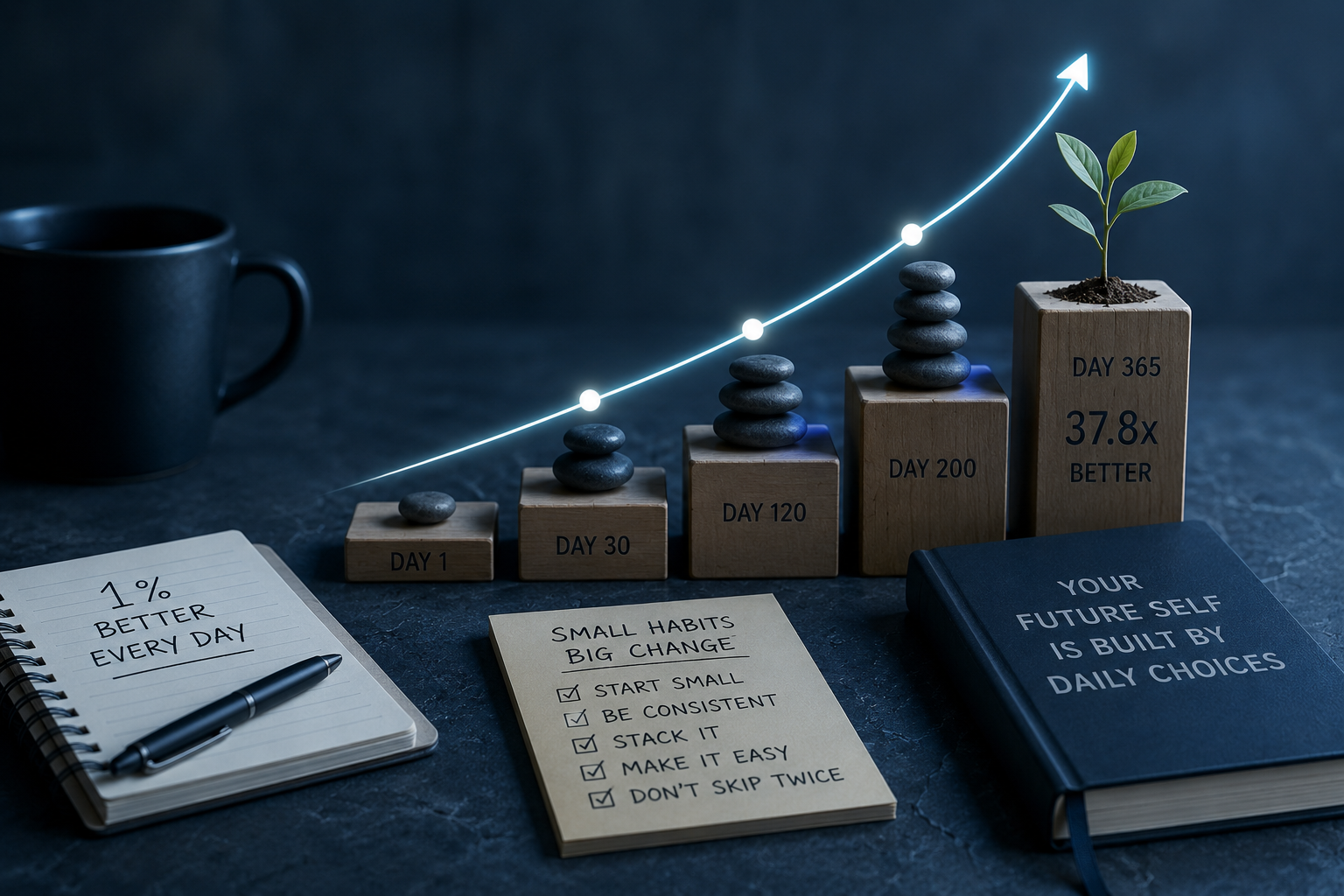
Here’s a number worth sitting with: 37.8. That’s what you get when you improve something by 1% a day and let it run for a year. One percent. Barely visible on any given Tuesday. Compounded over 365 days, it’s nearly 38 times better than where you started.
We picture transformation as a big event — a bold leap, a dramatic before-and-after. The data says otherwise. Real change arrives quietly, through small decisions repeated until they stop feeling like decisions. That’s the engine underneath every lasting result.
Whether the target is health, focus, work, or simple peace of mind, the outcome isn’t set by your motivation. It isn’t set by your goals. It’s set by your habits — the inputs you run every day. So let’s take the engine apart and see how it works.
Why Habits Matter More Than Motivation
Everyone knows the motivation surge. January 1st. Monday morning. That random afternoon when you suddenly want to change everything at once.
Here’s the problem: motivation is a spike, not a baseline. It burns hot and bright, then drops. Any plan that depends on it has a failure point built in from day one.
Habits run on different fuel. They don’t check how you feel before executing. You brush your teeth on bad days. You take the same route to work without a single conscious thought. That’s your brain’s autopilot — a system that runs whether you’re inspired or not. It’s already running dozens of routines right now. The only question is whether you wrote them on purpose.
The whole game is choosing, deliberately, which routines get installed.
Small Is Powerful (And Sustainable)
Most new habits fail for one diagnosable reason: the starting size is wrong.
- “I’ll work out for an hour every day.”
- “I’ll never eat sugar again.”
- “I’ll wake up at 5 a.m. from now on.”
Admirable ambition. Terrible engineering. James Clear puts it precisely in Atomic Habits: “You do not rise to the level of your goals. You fall to the level of your systems.”
So shrink the input until it can’t fail.
Instead of reading for an hour, read for 5 minutes. Instead of meditating for 20 minutes, do 2. Instead of rebuilding your whole morning, make your bed.
A small habit is easy to start, hard to talk yourself out of, and doesn’t burn you out. And small inputs stack. That’s the point.
The Compound Effect of Tiny Changes
Habits behave like compound interest, and the math runs in both directions.
That 1% daily gain? Nearly 37 times better over a year. Now run it in reverse: a 1% daily slide feels like nothing — until you check the balance and you’re somewhere you never chose to be.
Here’s the honest version: you are always becoming someone. There’s no neutral setting. The only open question is who.
Every daily action is a vote for a particular future self. A walk today is a vote for a healthier you. A kind word is a vote for a steadier, more grounded you. Show up — even at small scale — and you’re casting votes for the person you’re building. The tally runs whether you watch it or not.
How to Build a Habit That Lasts
That’s the why. Now the build spec.
1. Start Ridiculously Small
Easier means more repetitions, and repetitions are the only currency that counts. Want to journal daily? Write one sentence. Want more water? One glass, in the morning. Your job isn’t to prove discipline. Your job is to show up so consistently it gets boring.
2. Anchor It to Something You Already Do
This is habit stacking — plugging the new routine into one that already runs:
- After I brush my teeth, I’ll write in my journal.
- After I make coffee, I’ll stretch for one minute.
- After I shut my laptop, I’ll go for a walk.
Tied to an existing routine, the new habit inherits its reliability. It stops being another item on the to-do list and becomes part of the machinery.
3. Make It Easy to Win
Design the environment so the habit is the path of least resistance. Want to read more? Book on the pillow. Want to eat better? Fruit on the counter. Willpower fades by evening; good design works around the clock.
And celebrate the small wins, even when it feels silly. That quick internal “Yes — did it” is a real signal, and your brain logs it. A tiny hit of success wires the loop for the next repetition.
4. Be Flexible, But Don’t Skip Twice
One missed day is noise. Two missed days in a row is a trend — that’s where habits actually unravel.
Life will interfere. When it does, skip the guilt and log the rule: back on track tomorrow, no exceptions. Your identity isn’t defined by a perfect record. It’s defined by how fast you resume.
Shifting Your Identity Through Habits
Here’s the most powerful output of the whole system: habits don’t just change what you do. They update who you think you are.
You stop saying “I’m trying to become a reader” and start saying “I’m a reader.” You stop “working on being healthy” and become “someone who takes care of my body.”
Identity-based habits are sticky by design. When a behavior matches who you believe you are, repeating it stops requiring force.
So swap the goal question for the identity question. Not “I want to lose 10 pounds” — instead, “What would a healthy person do today?” Then do that thing. Then do it again tomorrow.
When You Fall Off (Because You Will)
Everyone stumbles. Everyone loses momentum. That’s not a bug in you; it’s the standard operating condition of being human.
The critical move: don’t let one bad day cascade into a bad week. Don’t let a broken streak get reclassified as the end of progress. Run a diagnostic, not a trial.
- What triggered the slip?
- What can I adjust next time?
- What would “being kind to myself” look like right now?
Self-compassion isn’t soft — it’s part of the maintenance schedule. Progress isn’t linear. But every time you recommit, you’re strengthening the exact muscle that matters most: the restart.
A Quiet Revolution
There’s something quietly rebellious about building slow habits in a world optimized for instant gratification. While everyone else chases quick fixes, you’re running a longer, better strategy: patience, intention, steady growth.
You’re planting seeds that won’t bloom this week — and will absolutely bloom with time.
You may not see today’s habit paying off today. That doesn’t mean it isn’t working. You don’t see roots growing under the soil either. Your consistency is building foundation, whether or not it’s visible yet.
Final Thoughts
Big goals are exciting. Without small habits underneath them, they’re just announcements.
So don’t wait for the perfect moment, the perfect plan, or the perfect version of yourself. Start now. Start small. Start again tomorrow.
You don’t need to overhaul your life. You need to make a few small promises to yourself — and keep them on repeat.
Because the person you become is simply the output of what you choose to do. Again. And again. And again.